legislation > Animal Welfare Act > public input
The text below is provided for historical context. It illustrates one example of the USDA requesting public input on the administration and enforcement of a federal law.
THE USDA MADE PROPOSED CHANGES TO THE ANIMAL WELFARE REGULATIONS AND ASKED FOR COMMENTS FROM THE PUBLIC in 2017.
The USDA amended its commercial licensing requirements. These amendments were a result of more than 47,000 comments it received in 2017 after seeking public input regarding its licensing requirements.
Details of their recommendations can be found at the link below:
FEDERAL REGISTER:
ANIMAL WELFARE; AMENDMENTS TO LICENSING PROVISIONS AND TO REQUIREMENTS FOR DOGS
_____________________________________________________________
BACKGROUND: ORIGINAL ISSUE AND 2017 COMMENTS
The Animal Welfare Act is the federal law that requires certain businesses, such as animal breeders, dealers, exhibitors, and transporters, to obtain a federal license to operate.
The Animal and Plant Health Inspection Service (APHIS), within the USDA, is responsible for upholding and enforcing the AWA, which includes conducting inspections and issuing licenses. NOTE: The Department has the authority to make changes to the regulations that govern the AWA (the law). This advance notice for public comment is part of the legal process to allow changes to the regulations.
How the USDA interprets and enforces the AWA has contributed to the problem of puppy mills and has, through licensing and regulations, supported the growth of these businesses and others that exhibit animals, breed and sell animals for use in laboratory experiments, or use certain animals for commercial purposes.
On August 23, 2017, the USDA announced that it was considering changes to how it grants Animal Welfare Act (AWA) licenses — and reached out to the public for input.
Link from the USDA that provides further details about what types of regulatory changes the USDA was considering. Examples:
• Elimination of automatic renewals ("rubber-stamping" of licenses).
The USDA proposed issuing fixed-term licenses for dealers and exhibitors that expire after 3 years (current license is one year).
• Reduce licensing fees.
Current fees range from $40 to $760 for a regulated facility, depending on size. The USDA proposed one flat fee of $120 for every three years.
• Provide continual access to water.
The USDA proposed that all dogs in regulated facilities must have 24-hour access to water.
Below are some comments submitted by Animal Folks. This was submitted in 2017; provided here as an example of public input.
1. SUPPORT - Confiscation of animals
• USDA 2017 proposal: "Do you have specific concerns or recommendations for reducing regulatory burdens involving the licensing process or otherwise improving the licensing requirements under the AWA?"
• Background: When a license is revoked (due to the person not complying with the Animal Welfare Act), rarely are animals confiscated by the USDA; instead, the licensee is often allowed to dispose of the animals as he or she chooses. Confiscation of animals is already allowed under Part 2 of the Animal Welfare Regulations (Subpart I, Section 2.129).
Animal Folks strongly believes that new regulations need to be created that will increase and streamline the confiscation of animal(s) during the license revocation process or when animals are seen suffering during an inspection.
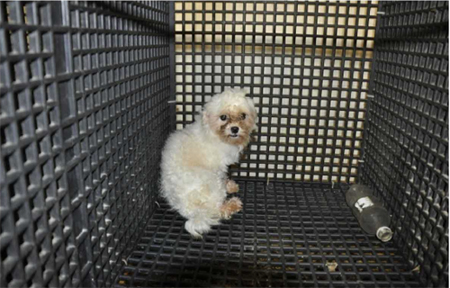
Above photo is from a former USDA-licensed facility in Minnesota. After years of chronic violations, this breeder's license was revoked in 2015; however, as with other breeder license revocation, the dogs were not confiscated.
As stated in the Settlement Agreement between the breeder and the USDA: "[Breeder] agrees to sell, donate, and/or transfer ownership and possession of any dogs on his premises, regardless of ownership, within twelve (12) weeks from the date the [breeder] signs this Settlement Agreement." This is standard language in many settlement agreements when a license is revoked. Other photos are at end of this post.
• REQUEST SUBMITTED IN 2017: We urge the USDA to prioritize the welfare of each animal by enhancing its procedures and training for the confiscation of animals during the revocation process. No longer should the licensee, as offender, be allowed to dispose of the animals. The health and well-being of each animal(s) must be the priority.
2. SUPPORT - Disclosure of any animal cruelty convictions.
• In 2017, the USDA proposed: "Require license applicants to disclose any animal cruelty convictions or other violations of Federal, State, or local laws or regulations pertaining to animals."
• Supporting data: Animal Folks had filed a complaint against a MN dog breeder (Rowell, located in Cass County) who was suspected of animal cruelty, resulting in an animal cruelty conviction and the seizure of the animals. At the time of the complaints and seizure, this kennel was licensed by the USDA.
Other dog breeders in Minnesota, such as Kathy Bauck and Dayna Bell, who violated state animal anti-cruelty statutes, were also licensed by the USDA and were in business during the time of the local investigations and subsequent legal actions.
The fact that breeders are still operating with a federal license while the facility is in violation of state and/or local laws must be challenged. Also, in many states, veterinarians are mandated reporters of cruelty; if an inspector is a licensed veterinarian for a state with reporting laws, he or she is required to report it.
• REQUEST SUBMITTED IN 2017: We support a requirement for license applicants to disclose any animal cruelty convictions or other violations of Federal, State, or local laws or regulations pertaining to animals. We also ask that procedures be established for USDA inspectors and personnel to report suspected or known animal cruelty at regulated facilities to local law enforcement. We ask that new procedures be created to enhance this reporting and tracking of the reports.
3. OPPOSE - Eliminating the application fee and reducing license fees.
• USDA 2017 proposal: The USDA is considering: "eliminating the application fee and annual license fee and assessing reasonable fees only for licenses issued."
• Background: Currently, the application fee for a USDA license is $10 and the annual renewal fee is on a sliding scale based on type of license and revenues generated. License fees range from $40 to $760.
• Supporting data: Considering that an animal, such as a puppy, if sold wholesale, could generate $200 (or more) each or, if sold retail, could be in the thousands of dollars each, a license fee of $40 to $760 is not a burden on a breeder, broker, auction house, or exhibitor.
• REQUEST SUBMITTED IN 2017: We oppose the USDA wanting to eliminate the application and annual licensing fee. Instead, we support raising the application fee and annual licensing fees to more accurately reflect the cost of administering the regulations and to reduce the burden on taxpayers. In addition to increasing the fees, create additional categories for Class A and B licensees who have higher gross sales (above $100,000) and/or number of animals.
4. SUPPORT - Streamlining how a license is denied, terminated, or suspended.
• USDA 2017 proposal: "Streamlining the procedures for denying a license application, terminating a license, and summarily suspending a license."
• Background: Currently, an individual is granted an initial USDA license if he or she meets the definition of the Animal Welfare Act and his/her application is approved. The individual is then sent a renewal application form six weeks in advance of the renewal date — each year. The bottom of the form states:
"...I hereby acknowledge receipt of and agree to comply with all the regulations and standards in 9 CFR, Subpart A, Parts 1, 2, and 3. ..."
Signing of this form is called "self-certification" — and, for the renewal process, the USDA relies on licensees to "self-certify" rather than demonstrate compliance through an inspection. Essentially, the renewal process for a license is automatic — and administrative.
Licensees sign this form and yet many, as documented by inspection reports, do not comply with the regulations. The USDA still grants a renewal license, even though the USDA knows the licensee is out of compliance.
• Supporting data: Animal Folks filed a complaint against S. Glenice Viken (41-A-0298; located in Roseau County, MN) with the USDA, showing repeated violations of the Animal Welfare Act over many years. As of this date, this breeder is still licensed by the USDA. It is assumed that each year when her license is renewed, this breeder has continued to sign the renewal form that states she is in compliance (self-certify) . Allowing a breeder to commit and then "fix" the same violations year after year is in violation of current law.
• REQUEST SUBMITTED IN 2017: No license should be automatically renewed. We ask the USDA to establish new regulations where the licensee must demonstrate (i.e., through an inspection) that he/she is in compliance with the standards of the Animal Welfare Act prior to having his/her license renewed. These procedures are especially needed when a licensee has repeatedly violated the Animal Welfare Act, as documented through inspections. Within the new regulations, provide details of proper notice and justification for action so the licensee is clear as to what was expected. For the welfare of the animals, the burden must be placed on the licensee to prove why he or she should be reinstated.
5. SUPPORT - Restrict individuals and businesses who have violated the law from working at another regulated entity or applying for a license; close loopholes.
• USDA is proposing: "Strengthening existing prohibitions to expressly restrict individuals and businesses whose licenses have been suspended or revoked from working for other regulated entities, and prevent individuals with histories of noncompliance (or orders suspending or revoking a license) from applying for new licenses through different individuals or business names."
• Supporting data: Animal Folks filed a complaint against two dog breeders located in Morrison County, Minnesota, requesting an investigation of a Consent Order by the USDA. One of the breeders was being investigated by the USDA for a history of violations; however, this breeder cancelled her USDA license during the process and the investigation was then stopped.
The kennel was flipped to the breeder's daughter-in-law who was granted a new USDA license on the same day as the license cancellation and on the same day of the Consent Order. Further, no restrictions were placed on the Consent Order prohibiting the original kennel owner from working at the newly-licensed kennel, and the original owner was allowed to reapply for a license in just three months following the Order, essentially wiping out any prior violations.
This breeder had also violated a local law by exceeding her limit of adult dogs in four separate years; violating local law is a violation of the AWA.
• REQUEST SUBMITTED IN 2017: Some individuals and businesses, whose licenses have been suspended or revoked, have contined to work at other regulated facilities. Other individuals with history of noncompliance have applied for new licenses through a different individual or business. We support strengthening prohibitions to restrict these loopholes. Further, we ask the USDA to create regulations that do not allow a licensee to cancel his or her license during a revocation process in order to stop the enforcement efforts and circumvent the law.
6. OPPOSE - Expand license expiration date
• USDA is proposing: "Establishing a firm expiration date for licenses (such as 3-5 years) after which the licensee would once again be required to affirmatively demonstrate compliance before obtaining another license."
• Background: The current licensing scheme allows for an initial license to be issued with renewal licenses granted each year. It is unclear as to why a longer expiration date should be considered or established.
APHIS already has the authority to enter and inspect a facility at any time during the initial and renewal processes to ensure that AWA standards and the welfare of the animals are met. Providing additional time for APHIS to do what they are already allowed to do by law does not add any value to the process — in fact, “more time” would extend any pain and suffering of animals already at risk, making this action unreasonable.
Further, as noted on inspection reports, a key factor to the efficiency of inspections is the lack of a responsible person on site, requiring inspectors to return to the facility repeatedly — adding time to the process. We believe APHIS is in violation of the Animal Welfare Act each time it grants a renewal license when the agency has evidence that the licensee is out of compliance but has “self-certified” that they are in compliance.
• REQUEST SUBMITTED IN 2017:
We oppose expanding the license expiration date to 3-5 years and ask the USDA to keep the expiration date to one year. Extending the license date could place animals, who may already be suffering, at greater risk. As for demonstrating compliance, we ask the USDA to shift away from self-certification and establish new criteria to be used in the decisionmaking for granting a renewal license. For example: 1) add a regulation that states the licensee "must pass an agency compliance inspection of its facilities before the renewal license may be issued;" and/or allow the annual inspection to be used to meet this condition; 2) instruct inspectors to increase the number and type of photos and video used as documentation; 3) include other facts that may contribute to the decision, such as licensee violation of state and local laws.
ADDITIONAL PHOTOS - Support strengthening of regulations to increase confiscation of animals during suspension or revocation of license.
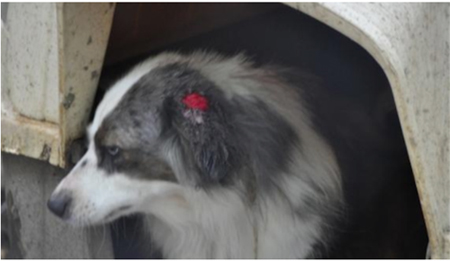
Another former USDA-licensed breeder: Deloris Richards in Lyon County, MN.
License revoked, but no animals were confiscated - breeder allowed to dispose of the animals. Above photo shows fly strike due to lack of pest control. Source: USDA.
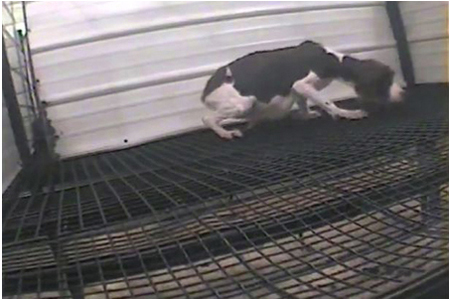
Former USDA-licensed breeder: Kathy Bauck in Otter Tail County, MN.
Notorious case with breeder convicted of animal cruelty. License terminated, but no
animals were confiscated - breeder allowed to dispose of the animals. Hundreds of dogs
at kennel. Photo above shows pregnant, emaciated dog. Source: CAPS.
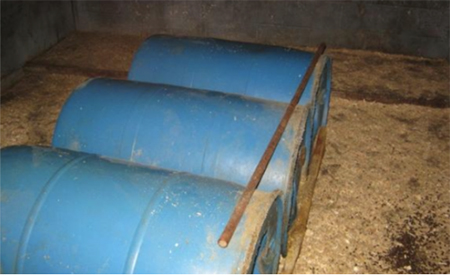
Former USDA-licensed breeder: Ken Schroeder in Faribault County, MN.
Breeder bred and sold animals to medical institutions. License revoked, but no
animals were confiscated. Photo above shows barrels where animals were kept which was allowed by the USDA. Source: USDA inspection.
LINK: Final Public Comments submitted by Animal Folks to the USDA in 2017
|